

A Typewriter at War

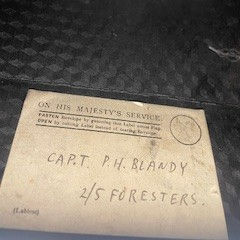
In the course of researching Sherwood Boys, I have been contacted by many people about individuals who served in the battalion. But perhaps none of these have been more unusual than the lady who just before Christmas 2025 got in touch with me about Captain Patrick Henry Blandy. The reason, she told me, was that she had his typewriter, and would I like a photograph of it?
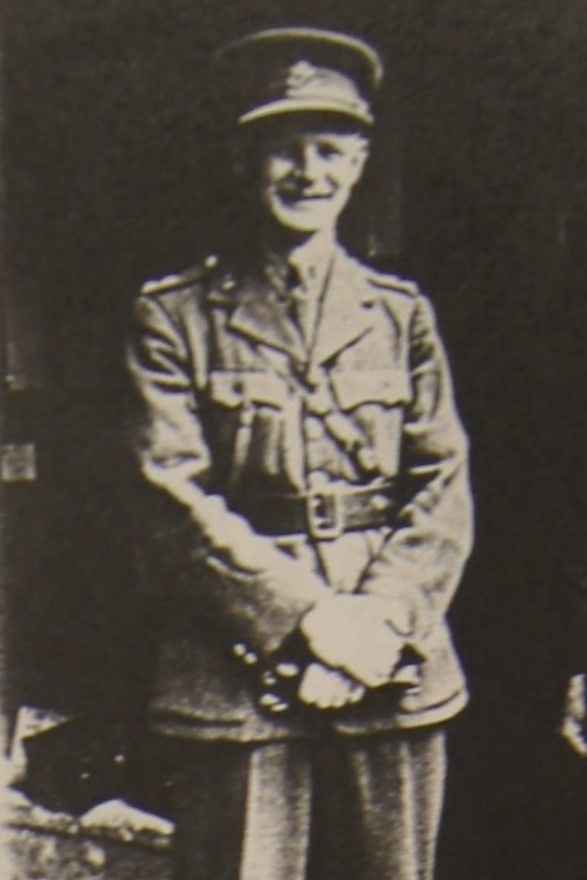
‘Why would I be interested in that?’ was my immediate reaction. Blandy had joined the 2/5th Foresters in July 1940 and became its adjutant the following month, in which role the typewriter must have had much use, but he did not go overseas with the battalion in 1942, so was only a minor figure in their story. But then I thought a little more about the machine itself. I had made two references to typewriters in my book. In 1940, Sergeant Frank Hession of the Administration Platoon had thrown his typewriter away on entering the Dunkirk perimeter – not the most important piece of equipment to be transporting back to England after all. And entering Austria in 1945 Ken Charlesworth, who had been posted to Battalion HQ as a clerk precisely because he knew how to type, remembered that they had captured half a dozen German typewriters which he thought much than their British ones, as well as large quantities of duplicating paper. It dawned on me that in between these two bookends to the story, the humble typewriter was in fact an absolutely vital piece of military equipment - and I had been using its outputs all through my research without even thinking about it.
I have literally thousands of pages of War Diary entries, Battle Reports, Intelligence Reports, Operational Orders, Administrative Orders, Training Instructions and numerous other miscellaneous documents, from battalion up to Army level, almost all of which were produced by some officer or clerk on a simple typewriter. Many of these have distribution lists of twenty or more. The 2/5th Foresters filled out their daily war diary entries manually prior to going to France in April 1940 (so before Blandy and his typewriter were posted to them), and a few diehard battalions, notably the 2/5th Leicesters, continued to do so throughout the war. But provided the adjutant or his assistants knew how to type, having the ability of efficiently duplicating all that paperwork using carbon paper must have been an immense time-saver and improvement. It is difficult to see how the armies of 1939-45 could have operated without typewriters.
Other aspects of the wartime bureaucracy were also reliant upon these machines. In verifying casualty figures and tracing prisoners of war, I have trawled hundreds of pages of casualty lists. During the war over 4,000 of these lists were produced by the army alone, separate documents for officers and nurses and for other ranks, and daily except for Sundays. They varied in length from just a few pages to forty or more. All laboriously compiled from unit and formation level casualty lists or intelligence from other sources such as the Red Cross. While there are errors, in proportion to the scale of the task they are surprisingly few – and usually corrected in later lists. An extraordinary effort, which must have consumed thousands of hours of clerical work, but vital to keep people at home informed about the fate of their loved ones.
The typing up of these casualty lists was no doubt done by women of the Auxiliary Territorial Service, freeing up male soldiers for the front-line or other more physical roles. But that was not true of all those documents generated in the field. After 1945 soldiers would use the administrative and clerical skills learnt in the army, including no doubt typing, to leave pre-war manual jobs and take up employment in industries such as sales, insurance and local government.
So, as we think of the transformational impact on both warfare and society of computers, the internet, and now perhaps AI, spare a thought for how the lowly typewriter helped win a war and changed lives.
Blandy’s machine incidentally was a Remington Compact Portable, manufactured in the late 1930s. And I am assured it has now been completely renovated and works beautifully.


Comments